Light is an endless, rich topic connecting science, philosophy, society. I keep exploring the relationship between light and matter, energy, perception. It’s a lifelong journey.
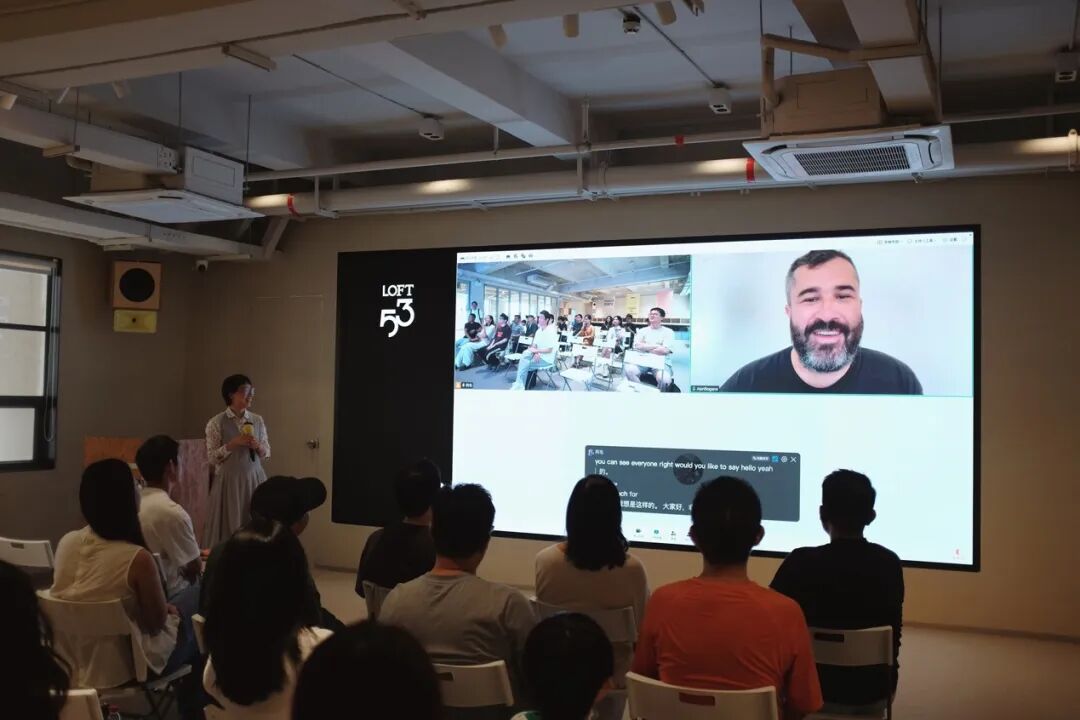
Alan Bogana:
I’m a Swiss artist based in Geneva. For 15 years, my practice has revolved around a main trajectory: light and its interactions with the living and the non-living. Light not as illumination or metaphor, but as something that acts, moves through bodies, structures environments, transforms perception and imagination, and sometimes controls behaviors without us noticing.
My mediums change: installations, sculptures, holograms, videos, digital simulations. But my interest in light persists. Some projects were inspired or developed in dialogue with scientists at CERN, EPFL in Lausanne, and astronomical observatories in the Atacama Desert, Chile. My research remains fundamentally speculative.
In 2012, I began exploring natural forms through digital simulation, using software developed for the film industry. Among them we have caustics—the dancing patterns at the bottom of swimming pools on sunny days, they are produced by water acting like a lens. Alongside simulations, I work with physical matter.
In the Stimmen series, acrylic glass blocks undergo two treatments: first, an electrical charge creates fine branching patterns called Lichtenberg figures. Then, a shot from an assault rifle shatters the block. The fragments unintentionally evoke minerals, mountains and organic forms. Simulation on one side, physical attack on the other. Both produce similar forms, and this convergence drives my research.
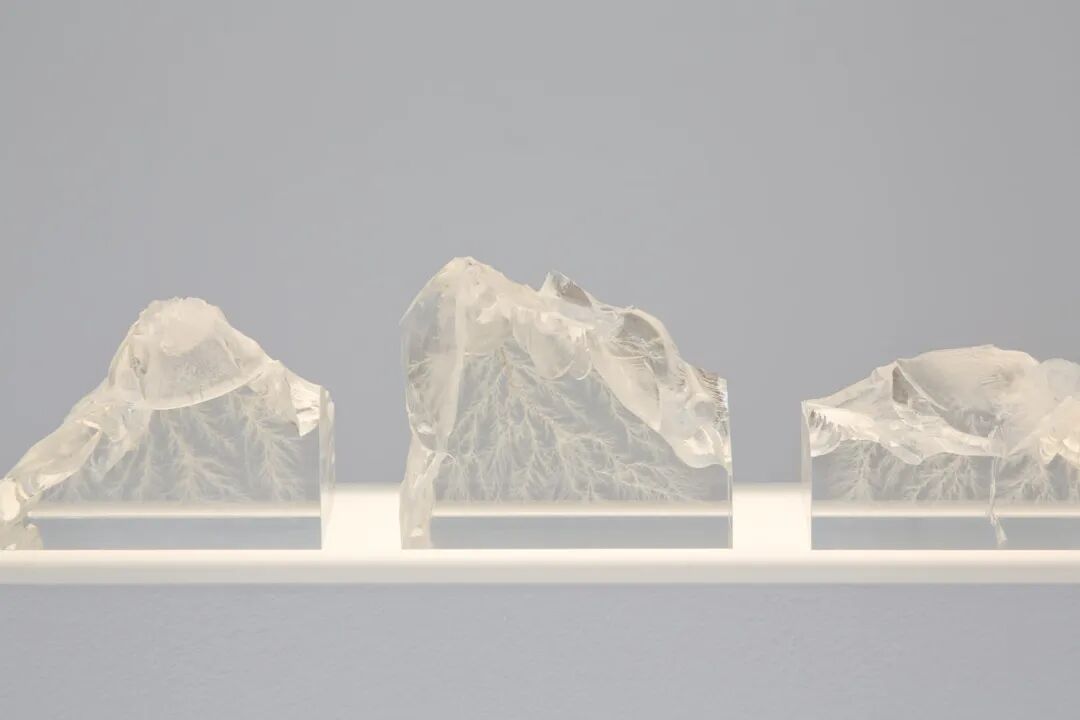
Nebenstimmen, 2013, sculpture
Crystal Fire pushes the logic further: what if flames had the optical properties of quartz crystal? The simulation creates an unsettling hybrid—like fire and water, physics and New Age imagination. It’s presented as a fire pit you can sit and contemplate.[1]
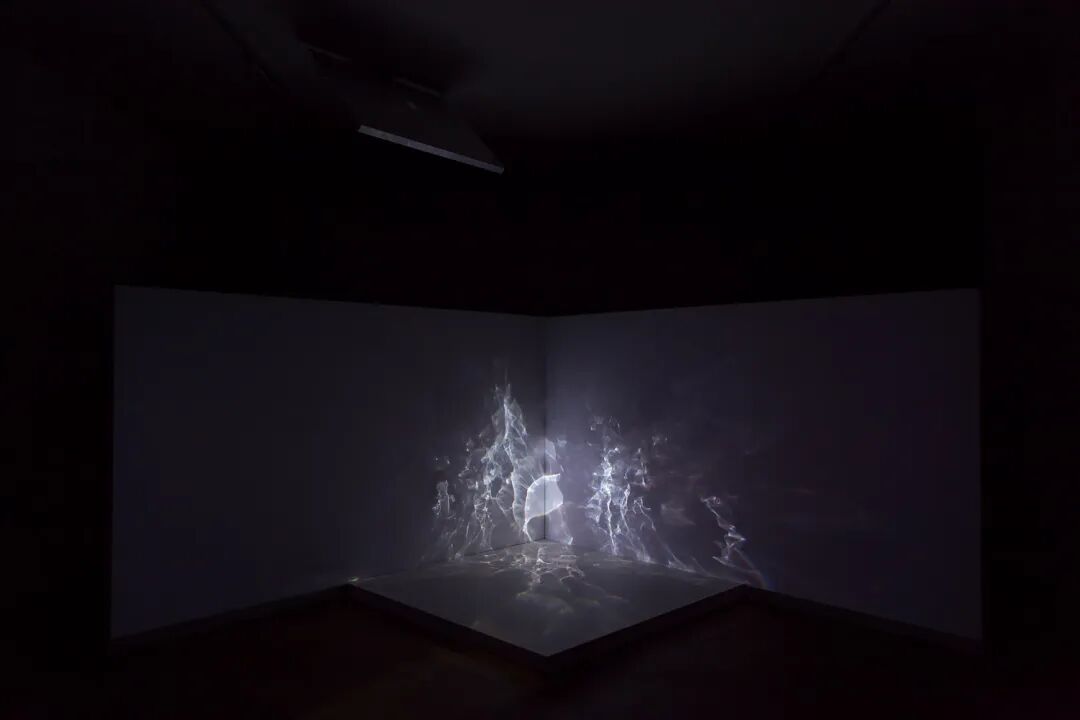
Crystal Fire, 2015, three-channel video
Last work in the Cave Caustics series: Flag of Convenience. A translucent flag metamorphoses into water, plastic, diamonds, indistinct real and fictional materials, projected as a ghostly presence. The simulation observes refraction linked to the mechanical folds of textile. The flag—a universal symbol of power—becomes porous, unstable, nationless.
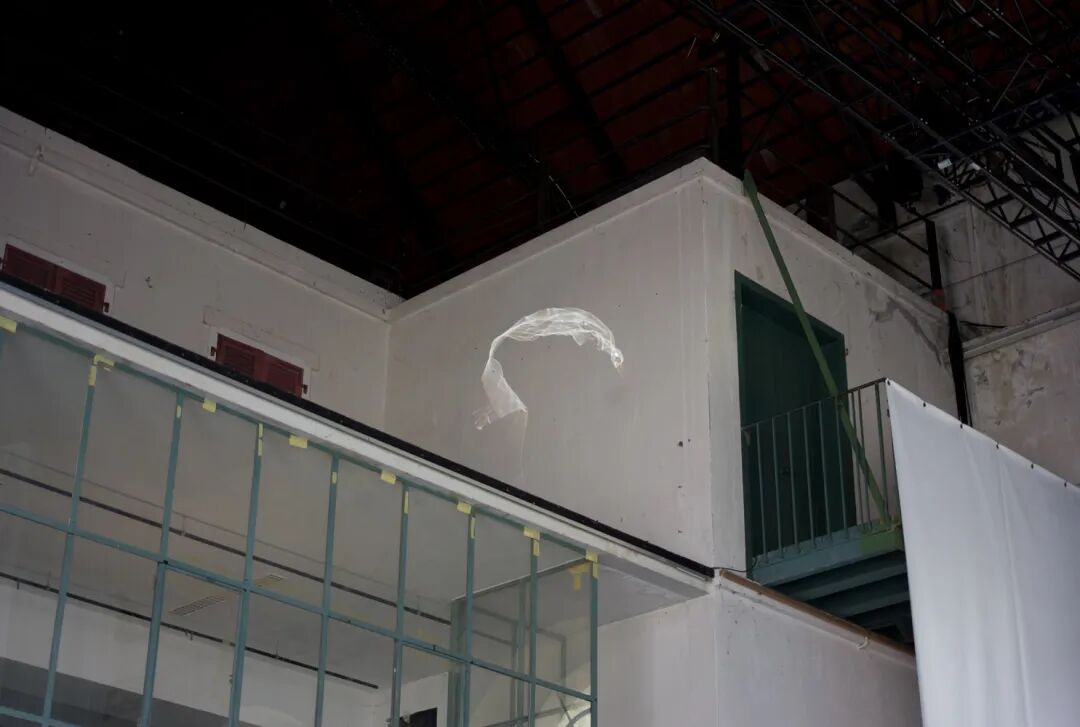
Flag of Convenience, 2014, video installation
In 2015, I started making holograms. I was drawn to their retro-futuristic imagination and their unique Divisibility Property: every fragment of a hologram restores the entire image, like looking through a smaller window. It’s very hard to document holograms on video; you have to experience them in person.
The Riddle of Pudelsphinx explores this idea of the fragment: here a mineral, doubled through a dual light source. These works became subjects of dialogue with scientists in cosmology, particle physics and photonics. I exhibited this hologram in the CERN canteen, and scientists were surprised.
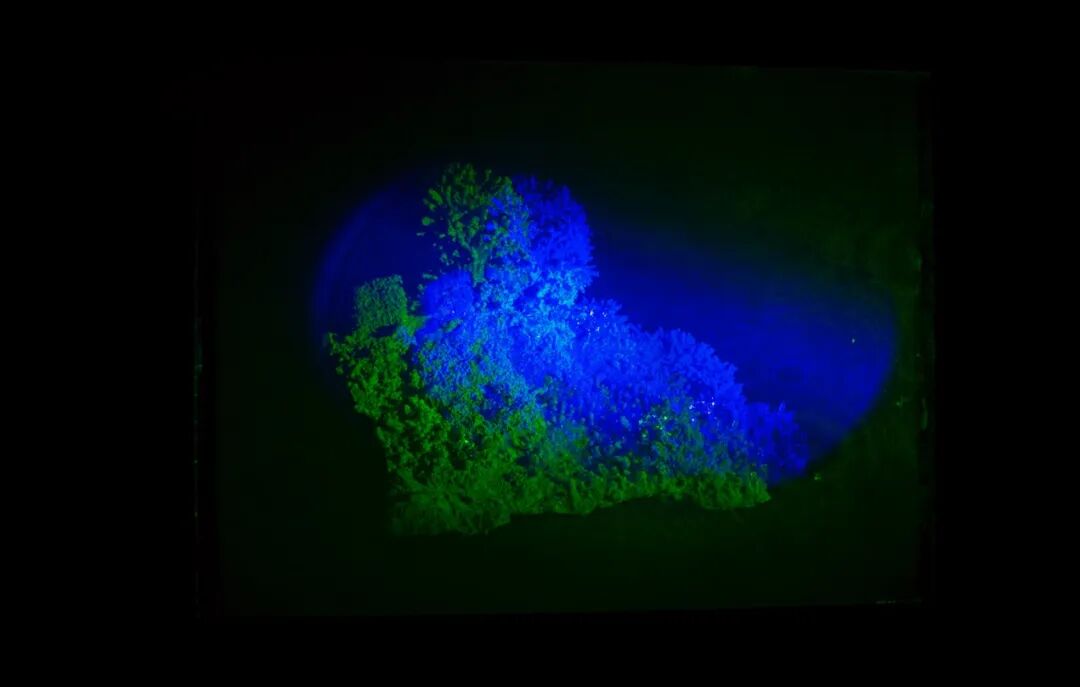
The Riddle of Pudelsphinx, 2015, hologram
In 2017, I started the Light Polluters Lab series, bringing my holography lab into exhibition spaces. It’s an intimate project: mapping the night sky as it will appear on my 50th birthday. I drilled holes into a metal screen; laser light through the holes imitates the twinkling of stars. Light is no longer just an optical phenomenon—it becomes a nuisance, a pollution, an imposed presence that erases our connection to the night sky.
I continued exploring future night skies with Journeys of Light, reconstructing the 2050 night sky for Kazan, Russia, and Basel, Switzerland, from real astronomical data.
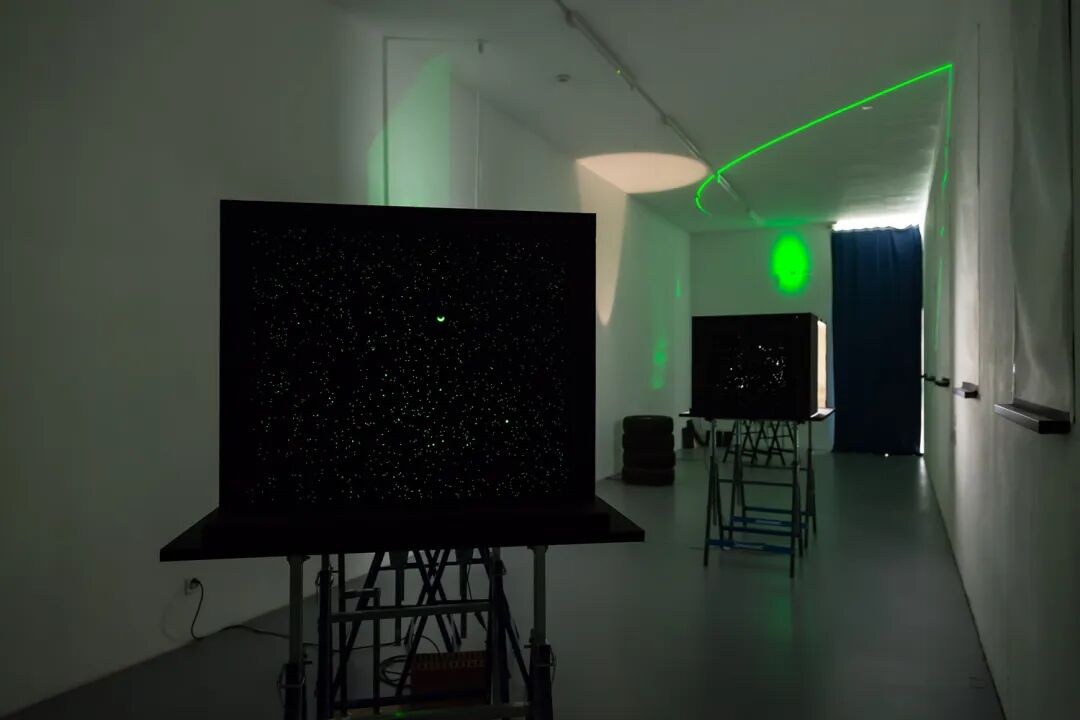
Light Polluters Lab, 2017, installation
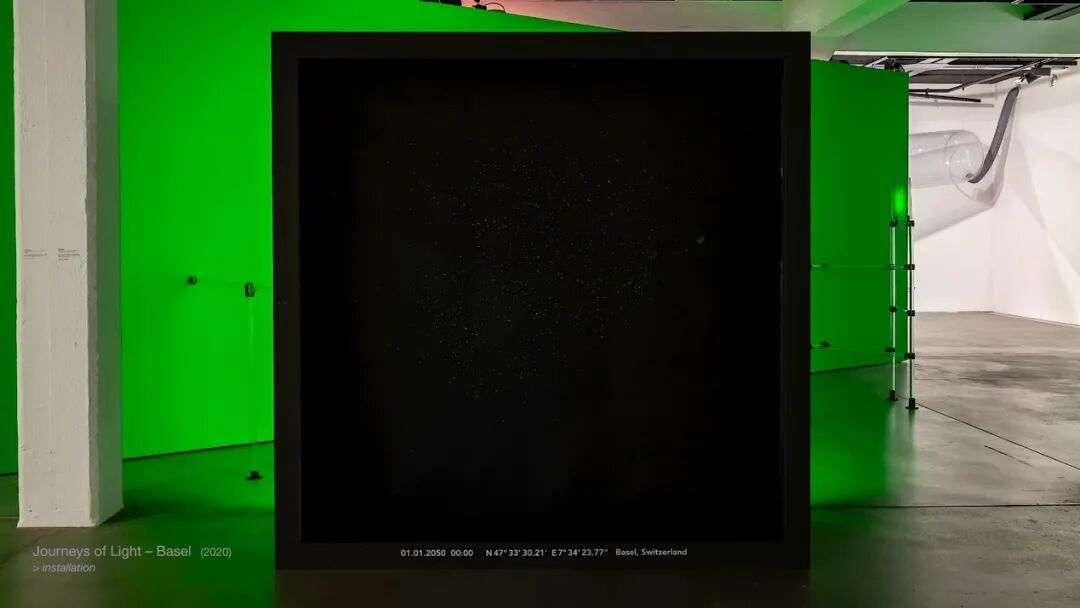
Journeys of Light–Basel, 2020, site-specific installation
In 2018, I was invited to create a mapping video for the Art Paris art fair, returning to simulations. Turbulent Drifts uses computer fluid dynamics software (from engineering) to wrap the Grand Palais façade in a fictional flow of air, water and heat. The Art Nouveau ornaments become obstacles, creating turbulences and vortices. I wanted to turn quantified scientific images into something psychedelic.
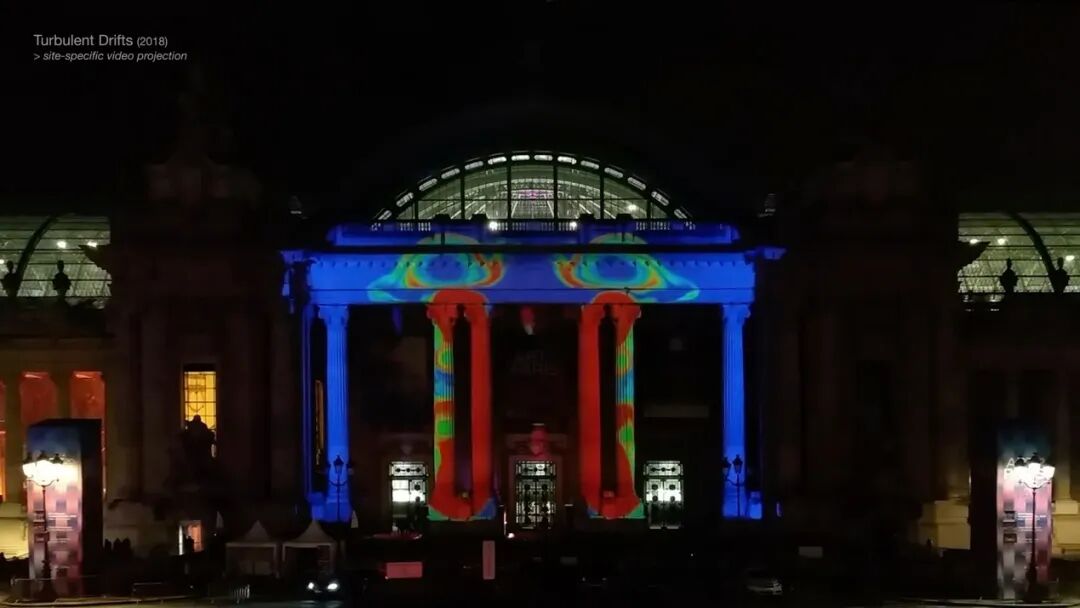
Turbulent Drifts, 2018, site-specific video
In 2020, I created Ionize Ionize!, a speculative video essay commissioned by Arts at CERN, filmed in a scintillation detector factory in Utrecht, Netherlands.
Scintillators are translucent materials that emit light when struck by invisible particles: cosmic rays, electrons, gamma rays, X-rays. The film makes the invisible visible, linking it to utopian speculations on humanity’s destiny. Light as a revealer of what passes through us without our knowing.
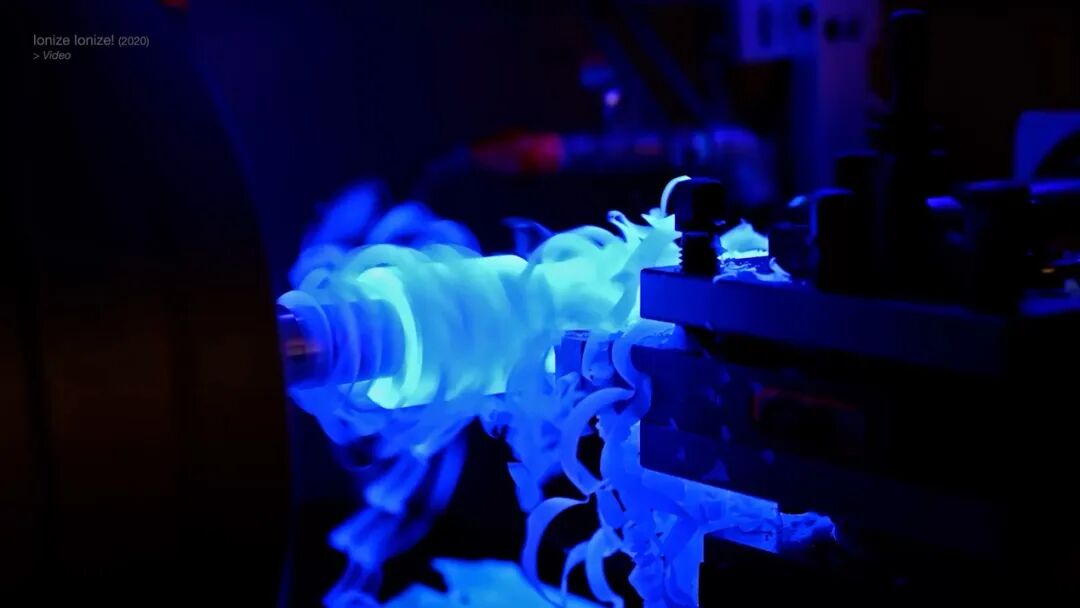
Ionize Ionize!, 2020, video
Back to 2020: I was supposed to do a 4-month residency in Shanghai and Hong Kong, but pandemic turned it into a remote residency. For two years, I tried to come to China for a project that became Restless Glows. In 2022, I worked remotely with Hong Kong.
I wondered: how to make a work about a place I’ve never visited? For 4 months, I watched a webcam of Victoria Harbor, recording 60 clips of Symphony of Lights. Among 60 recordings, I selected 3 stormy days. Raindrops on the lens diffracted and altered the light show, creating a unique version for me. The camera became an extension of my vision, exposed to the rain, lighting and air.
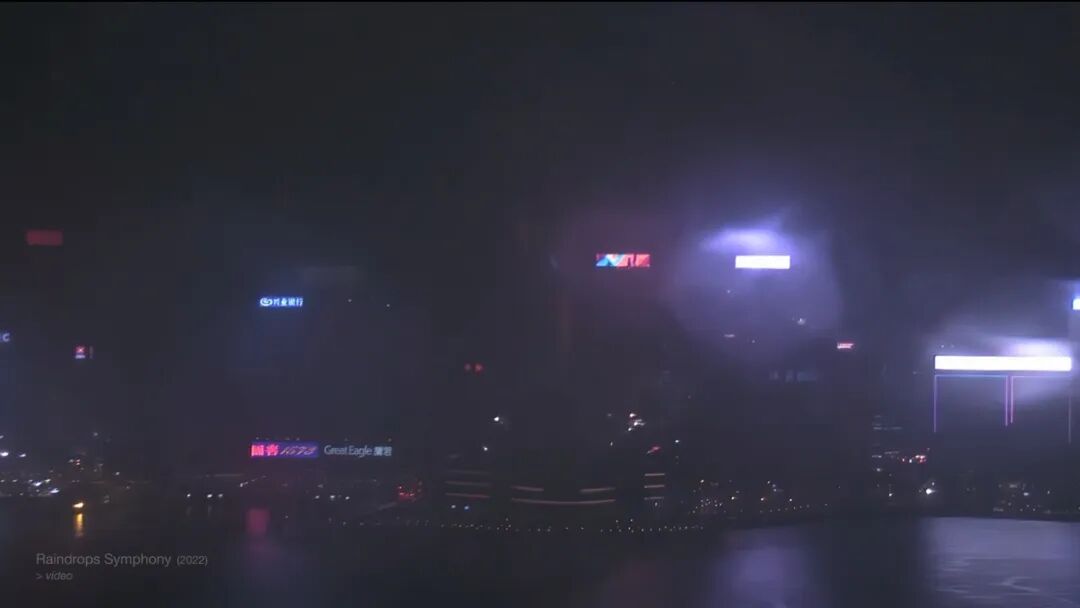
Raindrops Symphony, 2022, video
Alongside the video, I made 3D-printed sculptures: Relics of Lights, Clouds and Raindrops. I turned webcam images into 3D “postcards”: bright areas become peaks, dark areas flat surfaces. The landscapes formed by these 3D postcards do not correspond to any real place.
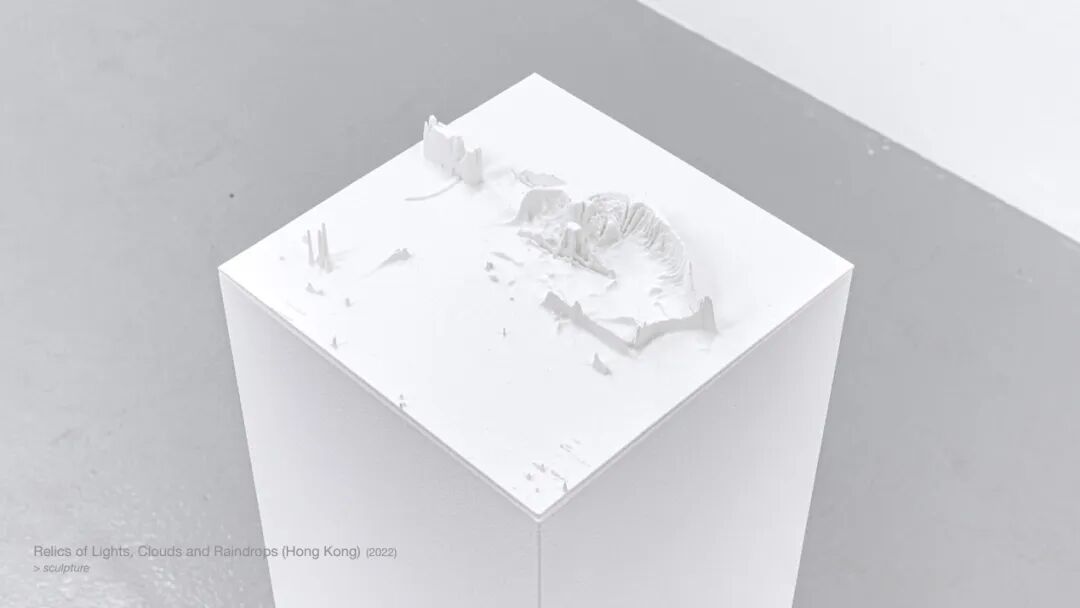
Relics of Lights, Clouds and Raindrops, 2022, sculpture
In 2023, I did a residency at EPFL. Core question: how did sensitivity to light shape the first living organisms on Earth? Light-oriented Ontologies explores this speculatively, using photopolymers, microfluidics and synthetic biology. The installation has 60 “sculptures” and a video.
Objects are solidifications of light in photosensitive resin—“frozen light crystals,” ambiguously evoking primitive visual organs, fossils, inorganic structures with organic appearance. The video amplifies the speculation: weaving making-of sequences, macro shots, and AI-generated images. Circadian rhythms emerge from sensitivity to the electromagnetic spectrum. Light is not an environment—it’s a constitutive force of life itself.
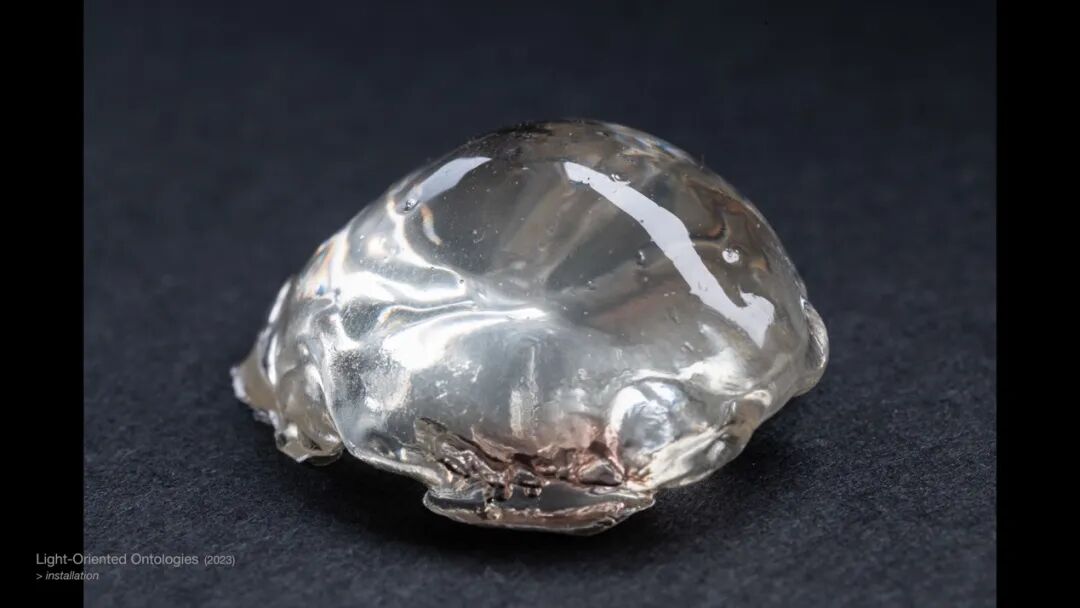
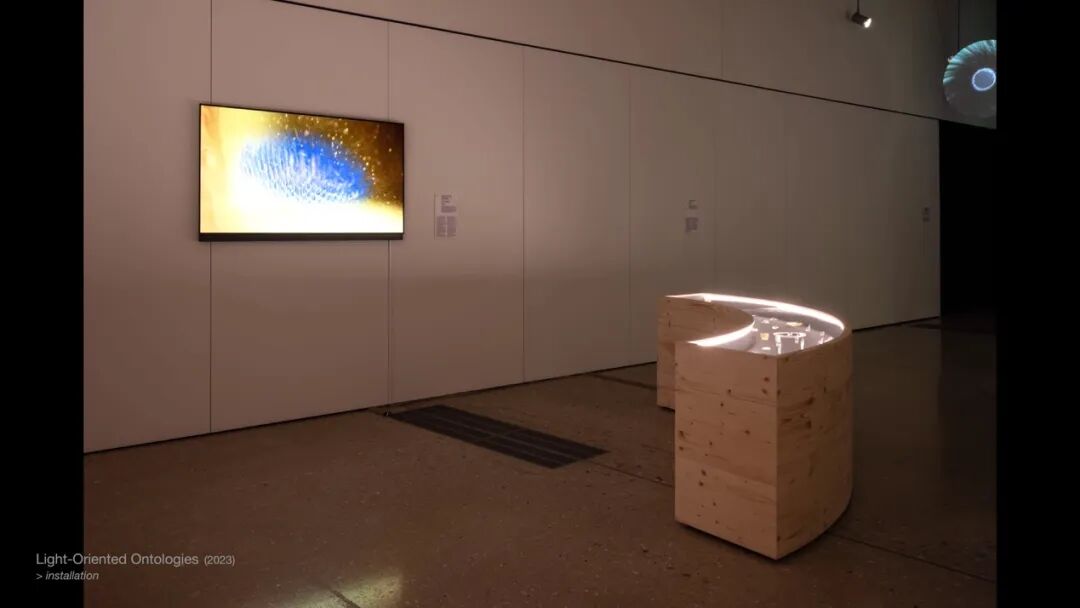
Light-Oriented Ontologies, 2023, installation
In 2024, I created Sensitive Flows and Glows for a light festival in northern France. It’s at the same time a projection screen, stained glass window, luminous fountain and a synthetic living organism, inspired by my EPFL residency.
Phosphorescent fluids circulate through channels inspired by microfluidics and organ-on-a-chip technology. The audience can interact with a laser pointer, directly altering the luminous fluid’s behavior.
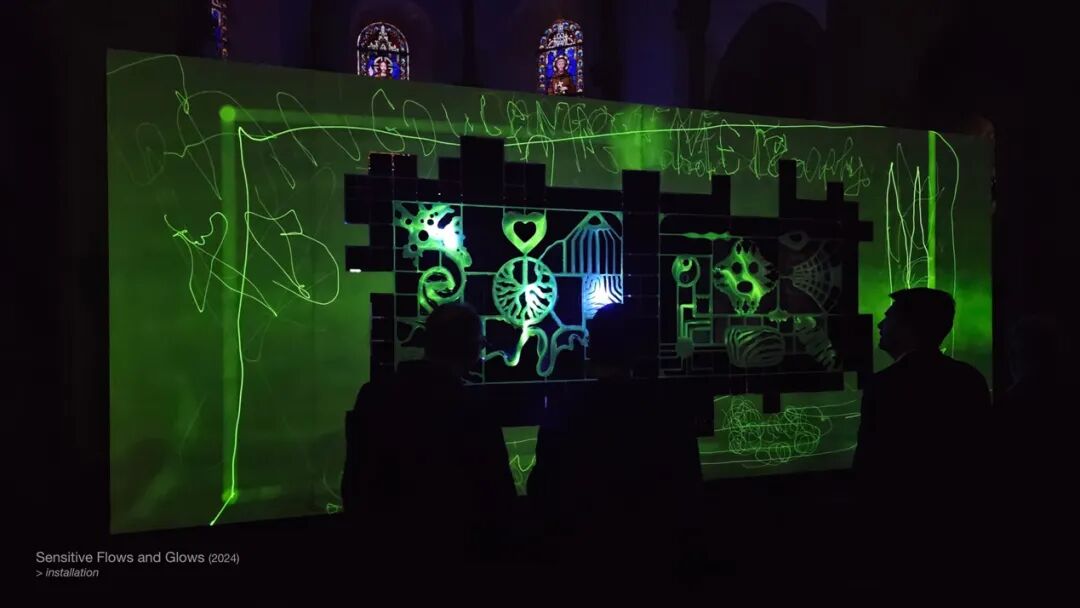
Sensitive Flows and Glows, 2024, installation
Now let me return to the central work of this screening: Restless Glows. This is the work’s first public preview worldwide. It covers laser acupuncture, Shenzhen LED facades, digital avatars, translucent bodies—a speculative essay at urban and cultural scale, with footage from Shanghai, Shenzhen, Hong Kong, Bolzano and Zurich.
Contemporary light regimes are ambivalent infrastructures: they heal, optimize, and capture attention. The film examines how knowledge circulates between East and West, and poses an ecological question: how do these luminous environments affect our bodies, desires and the planet?
Thank you so much for your attention. I’m looking forward to our discussion and questions.
Q&A
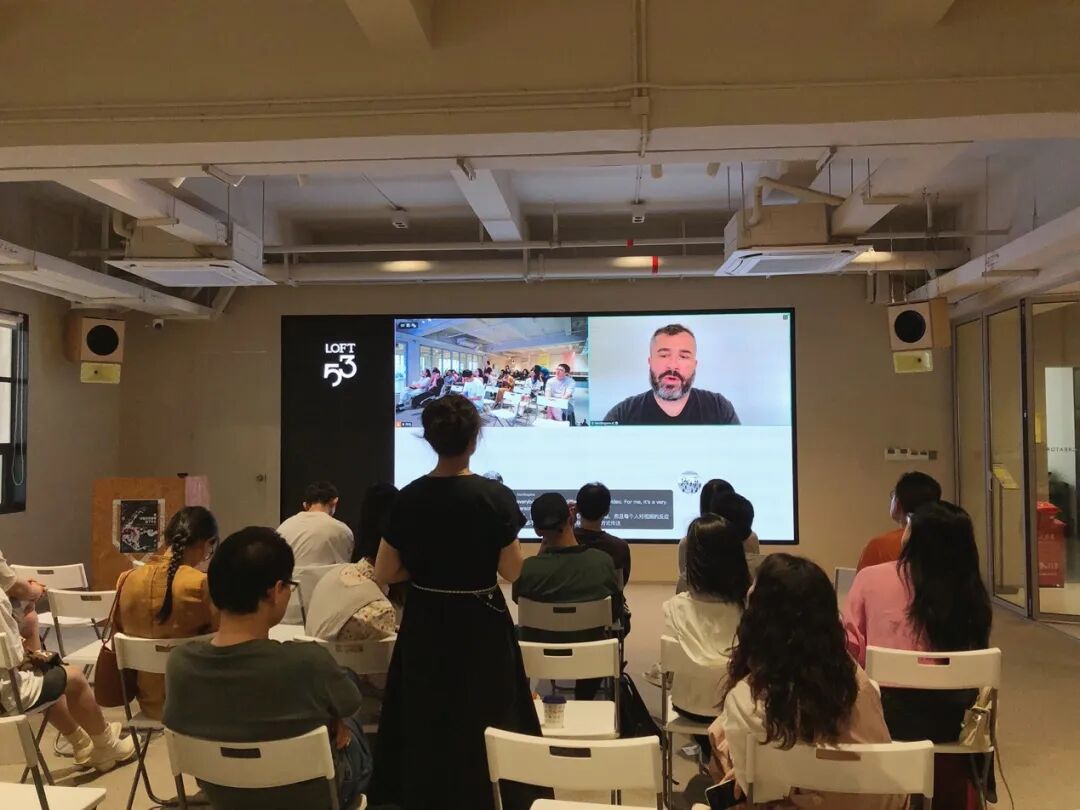
Q: How do you distinguish between natural light, medical lasers, urban artificial light, and the invisible spectrum, and discuss their different effects on the human body and perception?
A: We are sensitive to all forms of light, and everyone reacts differently. Restless Glows is a personal exploration, moving from large-scale infrastructural light to intimate, individual relationships with light. I’m interested in cultural differences—East and West—and how knowledge travels, like laser acupuncture, which I found developed in Europe and Russia.
The film is not documentary; it’s a subjective journey. I don’t strictly separate natural and artificial light, but we are constantly exposed to all kinds of light, visible and invisible, which disrupts our circadian rhythms. Blue light filters on phones are a response to this. Restless Glows is an open inquiry into light across disparate domains.
Q: I’m interested in string theory in physics. I think light is related to string theory, since all energy comes from strings. You could combine string theory and light to create something.
A: Thank you. The more I learn about science and theories of reality, the more curious I am about light at the quantum scale, including string theory. That’s why I often collaborated with scientists and their labs. Modern research deals with realities we can’t experience directly—we need technology for macro and nano scales.
Artists should inhabit these spaces and engage with these theories. As an artist, I can bridge specialized domains with a subjective perspective, without claiming to do science.
Q: How do you critically view the authoritative status of science?
A: Platforms like Arts at CERN and EPFL residencies allow direct artist-scientist dialogue, so art is not just an illustration of science. Science is a method for creating verifiable knowledge, the best we have, but it should evolve to include ethics, society and philosophy.
Artists and scientists both rely on intuition, imagination and curiosity. Dialogue sparks unexpected reflections. Art doesn’t explain science but keeps both from dominating our thinking.
Q: When collaborating with scientists, have there been times of communication difficulties or misunderstandings? How do you bridge these differences?
A: It depends on the scientist, time and openness. There’s no recipe. Some scientists don’t get my work at first; It takes time to find my niche and build a dialogue with them. I can’t master their specialization, but scientists value artists’ intuition and holistic thinking.
At CERN, we had philosophical talks about imagination in theoretical physics. Some scientists care more about philosophy, others about technique. I embrace my “ignorance” of their specialization; the dialogue itself is valuable, even if it doesn’t produce a work.
Q: What is “good art”? Scientists and artists have different standards; what’s your opinion?
A: Art is plural. Society is complex, so artistic practices should be diverse—some do art-science dialogue, others draw or paint. There’s no single standard. The key is to defend your perspective, in my case avoid illustrating science, and take a personal position.
Q: Has your work explored metaphysics, theology, or folklore? For example, the influence of light on human existence in traditional legends goes beyond the physical realm. During my residency in Switzerland many years ago, I encountered scientists collecting leaves to analyze the energy of a river over a year, which reminded me of my childhood in Chaoshan, where elders gave us talismanic water—also a form of “energy.” Even scientists may not fully understand the essence of their research; perhaps the legends of light are worth exploring in depth.
A: Yes. In Restless Glows, we explore TCM meridians as energy/light flow, discussed with doctors. There are studies seeing the body as an electric circuit. The film also shows Ötzi, the 5,000-year-old ice mummy in the Alps, with over 60 tattoos aligned with TCM meridians—ancient intuitive knowledge linked to traditional medicine.
In January, I saw the Northern Lights in Tromsø, Norway, for the first time. The Sami people have rich folklore: their word for aurora means “light that makes a sound.” Next year I’ll do a residency in northern Finland to research auroras—scientific phenomena tied to culture and myth.
Q: Thank you for choosing Shenzhen for the world’s first public preview. Restless Glows is both mesmerizing and rigorous, demonstrating profound research. Light possesses duality, existing between matter and immateriality; it is both physical and metaphysical, perhaps the true language of the universe. What is the core driving force behind your continued deep research into light? Are there any ultimate philosophical questions?
A: It started with media history and new media art, then curiosity about the physical principles behind light technologies. Holograms were a turning point: they reveal the counterintuitive relationship between light and matter—every fragment shows the whole image, unlike photography.
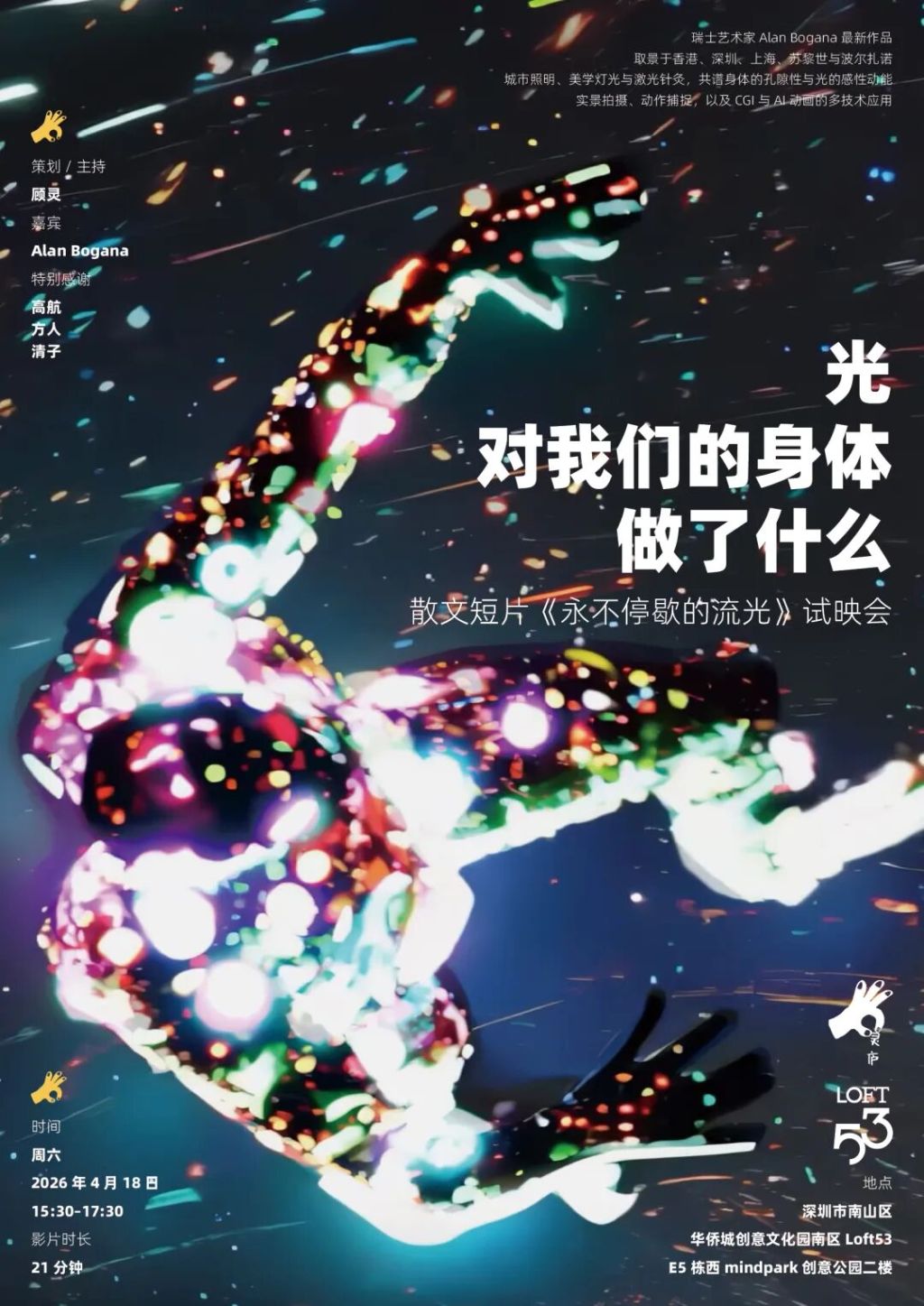
Light is an endless, rich topic connecting science, philosophy, society. I keep exploring the relationship between light and matter, energy, perception. It’s a lifelong journey.
Q: Why did you choose Shanghai, Shenzhen, and Hong Kong in China? Their city lights share similarities but also have historical differences. Why didn’t you choose cities like Tokyo or Osaka in Japan for your filming?
A: It started with Hong Kong’s Symphony of Lights and my failed residency. I’m interested in TCM and meridians as light flow. Each city has distinct history: Shanghai’s river view, Shenzhen’s modern rapid development, Hong Kong’s colonial background. I didn’t want a documentary, but a subjective exploration.
I also thought about Las Vegas—the origin of modern urban lighting—but focused on China for cultural links. Ideally, I’ll visit more cities for future works. I’ll also return to the Greater Bay Area to research light pollution.
Ling Gu: Due to time constraints, this sharing session has come to an end. Our art studio is called “Scintillating,” and we frequently organize interesting exhibition visits and curatorial activities. We also operate the podcast “One Leaf Folded” and the non-profit writing platform “Clear-headed.” We welcome everyone to follow and support us.
Alan: Thank you everyone for coming to this preview. It’s an honor to present Restless Glows to all of you. Thank you, Ling Gu, Val Kao, Fang Ren, and Mind Park. Feel free to reach out and stay in touch.
Follow up Q&A
Question from artist Chen Xu:
In the work Restless Glows, our imagination and experience of light spanned many dimensions, something seemingly only achievable through the medium of video. While viewing the works, I experienced a temporary forgetting of my own body—a kind of relationship with the body. So, how does the artist view the relationship between light technology as content and light technology (video) as a medium in video works?
Response:
Thank you for this beautiful question. One thing I actually wanted to mention during the presentation is something I experienced while showing Restless Glows. During the sequence of blinking pulsations, it was striking to see the audience physically illuminated by the light from the screen. It created a slightly surreal moment for me, as if the work was extending beyond itself and folding back into the space.
What made it even more meaningful is that this pulsation is derived from my own heartbeat, translated into light, then into a video sequence, and finally projected back onto the audience. So there is this loop, where physical light, technological mediation, and human presence become directly entangled.
In that sense, I don’t see a strict separation between “light as technology” and “light as medium.” They continuously inform and transform each other. Video is not just representing light, it is actively producing situations where light acts on bodies again.
Regarding your point about forgetting the body, I think this is very important. Immersive image systems can temporarily dissolve our bodily awareness, but at the same time, they are still deeply physical experiences. Light literally touches the body, affects perception, rhythm, even breathing.
So for me, the relationship is not about replacing the body, but about creating shifting states, where the body is sometimes foregrounded, sometimes suspended, but always implicated.
Question from Writer Wan Ting:
Have you ever paid attention to human emotions? The passage about “Crystal Fire” in your work left a deep impression on me: “It is presented as a fire pit you can sit and contemplate.” When I was a child, I would stare for a long time at the caustics formed by sunlight refracting in a pond in my hometown, or at the fire in the stove. Hesse also wrote about his love of watching fire. Why is it that the flickering light of nature can bring peace and tranquility, while the changing light of the city makes it so difficult? This is also related to light pollution and personal emotions.
Response:
Thank you for sharing this beautiful memory and reflection.
Yes, I’m very interested in human emotions and in how people relate to what they see and feel in front of a work. But I wouldn’t say that I try to guide or manipulate emotions in a specific direction. Today, many technologies and platforms already do this very efficiently. What interests me more is to open a space where different states can emerge: contemplation, hesitation, wonder, even a kind of quiet disorientation.
What you describe, watching water, fire, light reflections, or even looking at the night sky and stars, is something I feel very close to. These are experiences where attention slows down, and perception becomes almost suspended. There is something both soothing and slightly uncanny in them.
Crystal Fire plays with this tension. It refers to something familiar, like a fire you can sit with, but at the same time it becomes more unstable, more nervous, more intense. So you can still contemplate it, but the experience is not entirely comfortable or passive.
And you’re right, this makes me realize that I would like to understand more deeply what contemplation actually is, and how it works.
Interestingly, in my most recent work called “Fold Catastrophe”, shown just a few days ago, I moved in the opposite direction. It’s a very short piece, about 12 seconds, a kind of sudden apparition of simulated caustics projected in a staircase. There, I tried to interrupt contemplation rather than sustain it, to create something more abrupt, almost elusive, that escapes before you can settle into it.
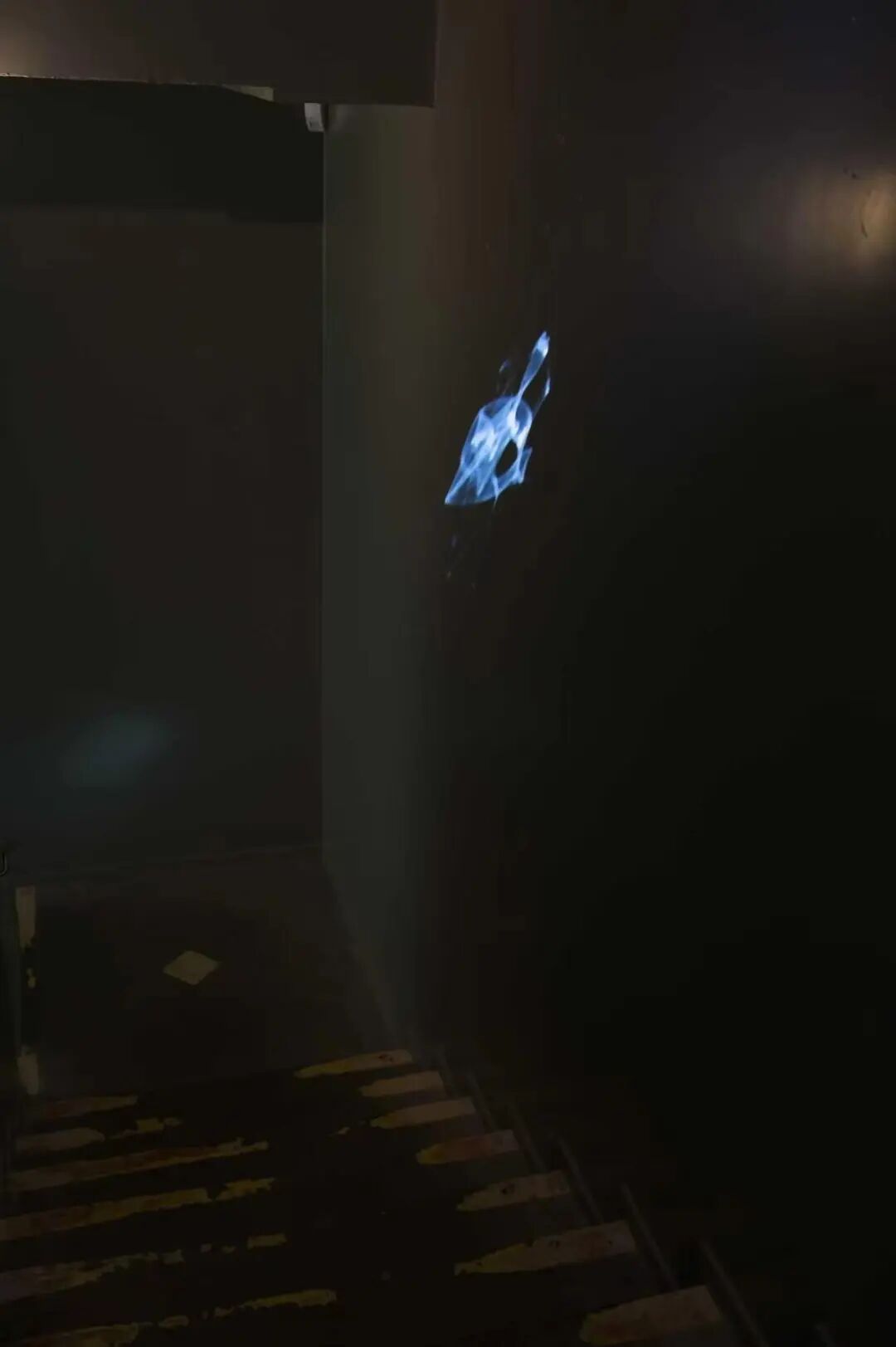
Fold Catastrophe (2026), Alan Bogana; site-specific video installation
So I think my work moves between these two poles: inviting contemplation, and at times, disrupting it.
Your question is very interesting. I think, over millennia, we have evolved in close relation to natural light phenomena, light that appears and disappears in subtle, unpredictable, and ephemeral ways, without any intention directed at us. Fire, water reflections, the night sky, these forms of light don’t ask anything from us. They simply exist, and we can meet them at our own pace.
Urban light, on the other hand, is often designed. It carries intentions, whether it’s advertising a product, promoting a set of values, or transmitting information. It is frequently made to attract, to capture attention, or to guide behavior. Because of this, the relationship changes. Instead of a space where you can drift and contemplate freely, you may feel addressed, targeted, or even slightly pressured to respond. There is often an expectation embedded in light itself.
So I think the difference lies not only in the visual qualities, but in the underlying intention. Natural light tends to open a space, while urban light often tries to occupy it.
Wan Ting replied:
Your reply deeply moved me, and I’m very grateful to Gu Ling for conveying my question to you, allowing me the opportunity to gain a deeper understanding of your work through this exchange, and giving me new insights.
I particularly like one sentence in your reply: “I wouldn’t say that I try to guide or manipulate emotions in a specific direction.” If we consider this a viewpoint on art, I think I deeply resonate with you. As a creator myself, I write novels, observe the world and people, but I believe that discovering stories is more important than creating them. While I may use artistic techniques to make my stories more powerful and beautiful, I always prioritize truth as the first principle of creation. Therefore, in literature, “guiding or manipulating” exists only as a technique, not as an intention.
So, can I understand it this way: your work attempts to build a bridge between the pure beauty of science and the beauty of philosophy, aiming to create a kind of reflection that is full of aesthetic experience yet relevant to life? I think there is nothing larger than the realm of “light.” The Chinese emphasize the unity of heaven and man, and light is the most universal, common, yet most mysterious thing connecting the universe and the human body. So I envy you, because you’ve found a theme that’s endless and never lacking in interest.
Speaking of interest, I think it’s absolutely crucial. I saw it in your new work! A mysterious, ever-changing beam of light peeks out from the gray stairwell, then climbs upwards, attracting curiosity while seemingly without purpose; unlike a clearly seductive beam of light, this beam, mimicking a caustic effect, is absolved by its own liveliness and richness, appearing more like it passed by unintentionally and then vanished without a trace. This is completely different from the deliberately designed, obviously intentional, and ultimately boring lights in the city.
I love the expression in your work and your curiosity about light. Thank you again for your reply, and I look forward to seeing more of your work! Oh, and I forgot to introduce myself; my name is Wan Ting, and I hope one day I’ll have the opportunity to show you my work.
Alan replied:
Dear Wan Ting,
Thank you so much for your beautiful message. I’m truly touched by your reflections, and very grateful that Gu Ling made this exchange possible.
I’m very happy to hear that my work resonates with your own practice. What you describe about “discovering” stories rather than constructing them feels very close to my approach as well. This attention to what emerges, rather than what is imposed, is something I deeply relate to.
Your reading of my work is very insightful. The idea of building bridges between different forms of knowledge and philosophical questions is indeed central to my research, but always through lived, perceptual, and aesthetic experiences rather than fixed meanings.
I was also particularly touched by your description of the light in Fold Catastrophe. The way you describe it as something almost autonomous, curious, and without clear intention captures something essential for me. This quality of presence, without demand, is precisely what I try to approach.
Thank you again for your generous words and your perspective. I would be very happy to discover your writing as well, and I hope we’ll have the chance to continue this conversation, maybe in person one day.
Warm regards,
Alan 🙂
Ling Gu curated, hosted and translated this event, and Hang Gao and Ling proofread the transcription.
About Alan Bogana
Alan Bogana is a Swiss artist based in Geneva. His practice spans installation, sculpture, video, and holography, investigating light as a material and speculative agent. His work has been presented at HeK in Basel, MIT Museum, UCCA Dune, and Copenhagen Contemporary, among other venues. He has undertaken residencies at CERN, EPFL, and the astronomical observatories in the Atacama Desert in Chile, and has been supported by Pro Helvetia and the City and Canton of Geneva.
With thanks to our media partners: SZEVENTS, MANA, and Lizi Plus.
[1] “New Age” broadly refers to a decentralized spiritual and social movement that originated in the West in the 1970s and 1980s. It combines ancient Eastern religions, mysticism, psychology, and environmentalism, advocating balance of body, mind, and spirit and individualized beliefs. It often takes forms such as New Age music, crystal healing, astrology, and meditation.—AI summary

