From Randian
by Iona Whittaker
translated by Ling
后天培养的品味?
尤伦斯当代艺术中心(中国 北京市 朝阳区酒仙桥路4号798艺术区内 )2013年5月5日—8月18日
克莱门特•格林伯格(Clement Greenberg)有言:艺术评论者必须表明其价值观。这句话听来明白,实则不然。在格林伯格身后出版的一本题为《自制美学》的书中,他对当时的艺术评论现状表示了极大的不满——格林伯格声称,有价值的评断应基于实在的审美体验,对他而言,这是不争的事实。他继而强调这类评断是“直觉所为”,而对该类直觉的定义,则必然仰赖所谓“品味”。他坚持,这类价值评断对“艺术的贡献”而言是至关重要的。
本文如此开篇,是因为我一直都不乐见王兴伟的绘画。但是最近看了他在尤伦斯当代艺术中心的大型个展、草场地0100001画廊的手稿展及杜尚回顾展中他的一幅作品之后,我对其绘画有所改观。不过在大举表扬他之前,我想先就“喜欢”和“不喜欢”展开一下。对格林伯格说来,“艺术首先、且在绝大多数情况下,就是关于喜欢和不喜欢的问题——仅此而已”。褒扬与贬斥都是有效的或感染人的。好比读者反而更欣赏那些咄咄逼人的采访者——这类采访者自然也会受到被采访者的白眼;社会上绝大多数人都将精力耗费在贬斥而非褒扬某人某事。我们总将别人的错误记得最快最牢。消极事件比积极事件对人的发展所造成的影响会更为深刻——也许正如人性本身。
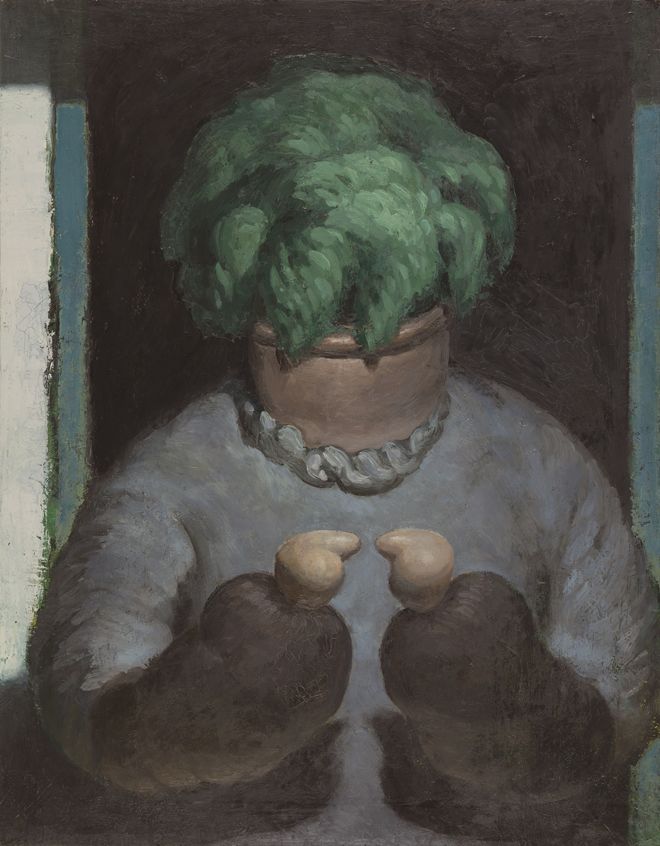
Wang Xingwei, “Untitled (Flowerpot Old Lady)”, oil on canvas, 117 x 91.5 cm, 2011
王兴伟,《无题(花盆老太太)》,布面油画,117 x 91.5 cm,2011
但从不喜欢到喜欢的转变又是怎么回事呢?一个人和曾为其所不喜的事物之间有着某种特别的关系。艺术评论家Peter Schjeldahl建议读者“追问”那些他们厌恶的作品,他相信对艺术的评断经常是从本能的不喜欢转向欣赏,反之亦然,那些头一眼就爱上的作品回过头来看时往往发现差强人意。 艺术家Edward Ruscha索性把好坏艺术家归纳为人们对其的反应,前者是先怀疑后赞叹,后者则是先赞叹后怀疑。这类喜好转变取决于“后天培养的品味”。那些不过分执着追求这类品味的人大概会更顺其自然:“逐渐变成”或“成长为”(有品位的人)。观察其他领域,如已逝哲学家Peter Goldie相信,某些品味是需要去主动追求的——比如假装自己真的喜欢某件作品直到真的喜欢(来自他所作的一场题为“牡蛎和歌剧院:如何后天培养品味?”的讲座)。
欣赏王兴伟的作品,可以说就需要这类后天培养的品味。他的作品可能还不值得赞叹,但最起码能让人明白。无论如何,他在尤伦斯艺术中心的大型个展与0100001画廊举行的手稿展同时举行,充分展现了他的活跃思考与高效画工——王兴伟的铅笔与笔刷扫过多种多样(或称零星)的对象,从企鹅、杜尚、社会现实主义、自画像、毛泽东、行李箱到死亡、艺术史、足球、纳粹与夏日划船。同一艺术家同时举办多个展览通常没什么好处,但这次却显然有益于观者对作品的体验。
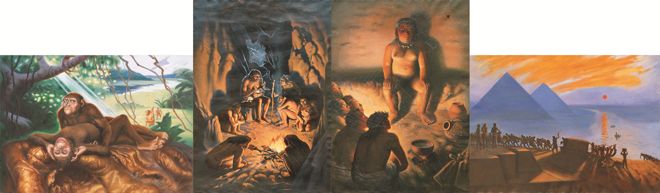
Wang Xingwei, “Developmental Step” (1-4), oil on canvas, 130 x 440 cm, 1997
王兴伟,《进化的步伐》(1-4),布面油画,130 x 440 cm,1997
不过首先,为什么会有人讨厌他的绘画呢?王兴伟将自己浮在一系列奇怪的照片流中;与传统美术相比,他的绘画更接近电影,也就是某一特定人物形象或姿势在一系列连续帧中反复出现,偶有微调。比如一位在窗户中和一个花盆一同出现的老太太,她的双手被画成一幅笨拙的手套,手里明显捏着针头想要穿线(《无题(盆景老太太)》);然后我们在其他画中看到她的头变成了花盆;她还出现在阳台上;房间里。这给人一种糟糕的试样感——艺术家好像在说,“你觉得这个怎么样?还是那个?”这种做法很过分,让人感觉到一种愚钝与执意的懒惰;它戳破了通常艺术家的那种充满自信、尊重构图的决策。没人会期望从一个好艺术家那儿得到这样的素材尝试,它更多像是某种漠然的试探——结果产出了这么多样品(显然是对艺术殿堂的侮辱)。
即便艺术家有意为之,但有些作品也着实可怖。作品《傻》(1997)让人回想起早前外国买家受用的那些最糟糕的“中国当代艺术”。《敲诈》(2004)模仿了英国西南部的廉价明信片上印着的那种无所事事的乡村场景。这些明显漠然的主题在其他更严肃或更恶毒的图像里更令人发指,比如一些以自画像形式出现的画面,或谋杀的场景,像《白求恩大夫》(2010)中被大卸八块的躯干。还有希特勒,在王兴伟信手捏来的人物图谱中同样占有一席之位。《进化的步伐》(1997)里不知羞耻的猴子们与坐在炉火边的原始人根本无法激起任何艺术的欢心。再有一些恼人的卡通风格绘画,如坐在平底船里的情侣,或像广告片里那样两人弯腰画出心形的情侣,或骑着旅行箱或摩托车一路滑翔的情侣——全是些肤浅直白的画面。这给人一种艺术家在盲目撒网、指望走运的感觉,同时也笼罩着一种僵硬和匆忙。
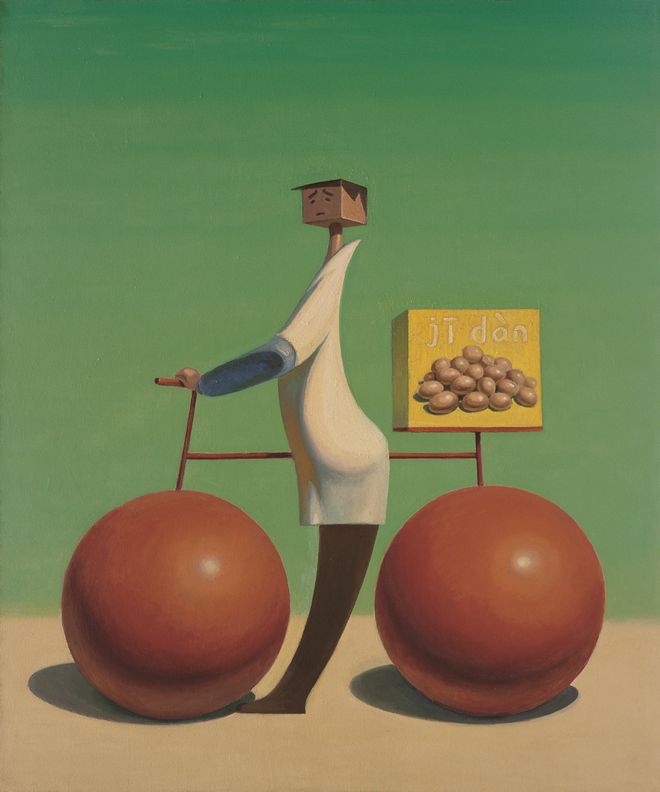
Wang Xingwei, “Untitled (Selling Eggs)”, oil on canvas, 240 x 200 cm, 2007
王兴伟,《无题(卖鸡蛋)》,布面油画,240 x 200 cm,2007
有人觉得王兴伟的画良莠不齐,也确实如此,他的绘画技巧与“风格”(不是单一风格,而是多元风格)确实看不出完整的连续性;《上升》(1999)是微妙而平滑的,但《无题(企鹅拉杆箱)》(2008)又好像是像素化的图形拼凑。《无题(救生筏里的护士和空姐)》(2005)中几位坐在橡皮艇里的女子形象均是对Tamara de Lempicka的效仿。《新兵》(1998)中,一位中国士兵的躺姿与马奈的名作《奥林匹亚》(1863)如出一辙。为什么要这么画呢?若要以“为什么不”来回答,那么光凭这些作品的表现或其艺术实践的持续性显然不够。这组作品的“灵光”从总体上看是相互矛盾的热情与漠然、躁动与恳切的集合体。这是否就是格林伯格口中那“艺术的贡献”呢?王兴伟本人拒绝以批评的口吻谈论自己的创作(即便尤伦斯艺术中心出版的画册里装了三段评论家的长篇大论作为令人望而生畏的批评尝试)。他自谦道,他的作品还谈不上“艺术”(“绘画有别于艺术”),并评价绘画本身“有点愚蠢”。
行文至此,该到了换种眼光的时候——无形中,观者在尤伦斯的展览现场放慢了脚步,对作品的厌恶被逐渐消解并转换为关注。确实,这里有不少动人之作。而那些不知羞耻的平庸之作反倒衬托出了这些真正“优秀”的作品——好像这一切都是艺术家故意安排好的。比如《原始人/猴子》“Neanderthal/Monkey”系列选用了难看的棕色调子与重复的画面内容,而摆在它旁边的《米达斯》(1997)则是一幅精美的油画作品,画中,一间黑屋子里,一手手托下巴、一手摸着一座金色男孩雕像的头、宛若《思想者》的杜尚,盯着他的酒架看。这批创作于1990年代的作品将艺术家的心机与精妙彰显无遗——当时,企鹅和空姐尚未真正登场。尤伦斯艺术中心的一面展墙上集中呈现的创作于1990年代中期的系列画作同样有见功力,该系列画作的主人公都是一名身穿赭色衬衫的男子,从《我的美好生活》(1993-5,这名男子挽着一名女子,倚着城市里的一条河上的一座桥共享夕阳)到《曙光》(1994,又是这对情侣,这回男子伸手指向远方)。这些画面很神秘,画得也很美,引发观者对画面背后个人故事的想象与自身的情感共鸣。另两件作品:《东方之路:下安源》(1995)和第二年创作的《盲》都与毛主席有关——这位伟大的领袖领导这片伟大的土地,一片斑斓的天空被他踏在脚下。绘画技法无可指摘;画面构图仍保留着强制性的宣传意旨。
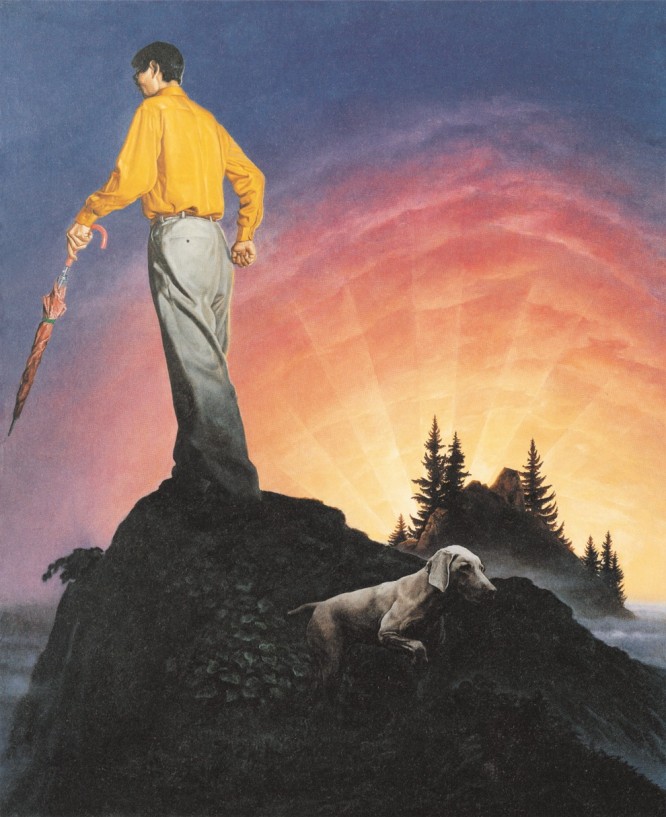
Wang Xingwei, “Blind”, oil on canvas, 200 x 180 cm, 1996
王兴伟,《盲》,布面油画,220 x 180 cm,1996
王兴伟作为一名画家的天才还向人指出了一个别处。与他对绘画主题的漠然相比(他说:“我想把画家当成是一个送信的人,他不应该对信的内容过分好奇。”),他的笔刷则热情洋溢。他炉火纯青的绘画技法在一张平面的画布上充分施展,为观者(也许同样为艺术家本人)带来愉悦——对衣服的褶皱或一束光晕的描画;叶卷、肌肤与质感在他的画笔下呼之欲出。王兴伟的另一项天才,是对经典大师杰作惟妙惟肖的复原,尤其是从构图上——如前文提到的作品《新兵》对马奈的《奥林匹亚》的效仿再次出现在《上升》中,它招摇着令人惊艳,炫耀着无所不知。
如果我们要找一个对艺术史大不敬、且拒绝单一风格的艺术家,那么王兴伟即是不二人选。此次在尤伦斯艺术中心的个人回顾展是艺术的,或许也恰是颇具智慧的嘲弄之举,不过,这位特立独行的艺术家也在此充分展现了他内在的哲思与绘画的天才。借张离对王兴伟的一段论述:
“王兴伟的作品很多意义并不是在画面上,而是针对于绘画这个庞大的系统而产生意义。他的作品不是独自的表达,而是像围棋子一样作用于关系中,这一关系是古今中外全部的绘画作品所组成的系统。”
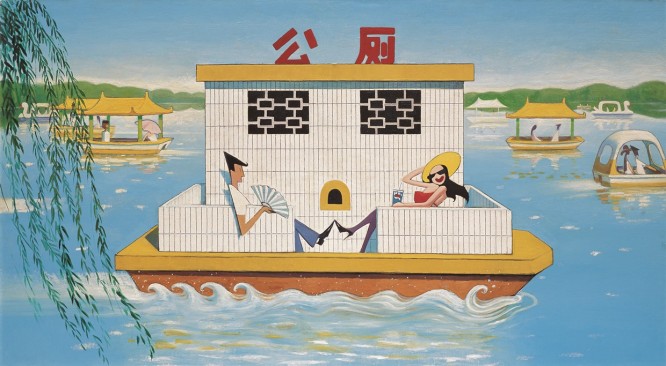
Wang Xingwei, “A Sunday Afternoon in the Youth Park”,oil on canvas, 165 x 300 cm, 2009
王兴伟,《青年公园的星期天下午》,布面油画,165 x 300 cm,2009
但是,有些人的“后天培养的品味”会在此时嘎然而止——这是因为,这种后天培养的品味似乎势必要和格林伯格所谓对某件作品的直觉与纯粹的“喜爱”相联系。观者于是更倾向于检视这份纯粹的喜爱,疑问在艺术世界中这份后天培养的品味究竟是什么?在当今的艺术世界,这类品味通常都与万般无奈的艺术市场撇不清关系。比如,艺术机构的负责人究竟是展出那些他们自己喜爱且觉得有意思的作品呢,还是执意为了教育公众,甚至自顾意淫观众是谁?尤伦斯艺术中心所公示的文字并未给反面意见留有余地,直直将王兴伟称作“前卫主义的英雄”及“一名关键人物”,其高深洞见“充分印证了博大精深的传统”;这些话编织出一个等着活捉直觉的陷阱。对那些出于直觉、本就喜爱王兴伟画作的人而言,肯定会直接忽略这面唠叨的文字墙;要是这面墙不摆在这里,说不定王兴伟会赚得更多的新粉丝?这种不甚恰当的说教方式或须归咎于当代艺术的展示方式的老套迂腐。
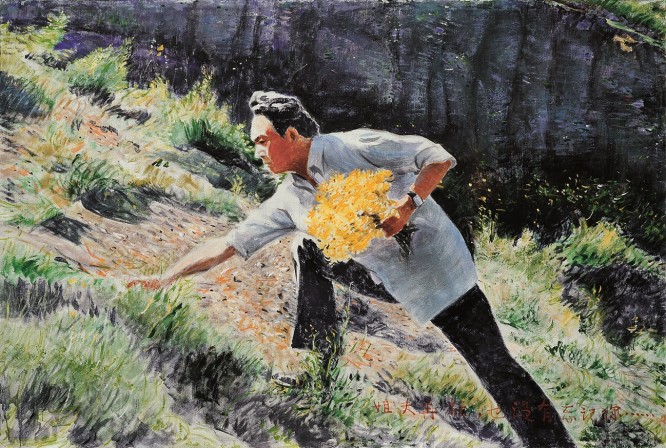
Wang Xingwei, “Brother-in-Law Is Busy Again But Didn’t Forget You”, oil on canvas, 200 x 300 cm, 2001
王兴伟,《姐夫再忙,也没忘记你……》,布面油画,200 x 300 cm,2001
格林伯格懊恼地抱怨艺术作品总被不断地“解释、分析、诠释、定位”,但就是避而不谈“面对艺术,把艺术纯粹当做艺术来体会”。如果要强拉各种关联性来谈王兴伟的作品则恰恰落入了圈套。但对“有意思”这个词的使用也须注意——它在直觉面前毫无用处,即并非出自纯粹的审美,而更多与知性的解读相关。用关联性来描述画作让人觉得作品都是缺乏对象(其他画作或艺术史)的单薄动词,一无所用。难道艺术家只有凭借他收集素材的“狡黠”才能赢得观者对其创作从厌恶到喜爱的平滑过度吗?王兴伟的画作只能总体去看、不能分别而论?也许,在当前的语境中,他的画作之所以需要后天培养的品味来加以欣赏,主要是仰赖于其画作之间、画作与艺术史之间的关联与精明——对某些事或某些艺术而言,这也是区分后天培养的品味与直觉的要素。如果欣赏王兴伟的作品要求后天培养的品味,那么应该遵循怎样的指导、如何进行培养?人们又究竟想要从艺术中获得什么?在中国的艺术界中,人们“喜爱”艺术的动机又是什么?
2010年,Peter Schjeldahl在一次公开讲座上发问“我们可以充满感情地讨论我们对艺术的讨论吗?” 本文对王兴伟创作的提示或探讨并不一定要被接受;或许这些问题提得多余或提得不够,从而我们发现,这些问题其实根本无法被解答——这或许也意味着,它们可以再被反复提出。这便是问题所在。
UCCA (798 Art District, No. 4 Jiuxianqiao Lu Chaoyang District, Beijing, China 100015) May 5 — August 18, 2013
As Clement Greenberg once remarked, an art critic is obliged to report their value judgements. It is a statement that seems obvious, yet isn’t, in fact. In an essay related to those published posthumously in “Homemade Esthetics” (sic). — a book in which he expressed great distaste with the state of art criticism — Greenberg stated that value judgements are the substance of aesthetic experience, a fact he refused to debate. He went on to assert that these judgements are “acts of intuition,” and that to define intuition of this kind one must resort to the word Taste. This kind of evaluation, he insisted, is essential “for the sake of what’s in art’s gift alone.”(1)
I invoke this essay because until now, I have disliked looking at Wang Xingwei’s paintings. Recently, however, and in the wake of seeing his work at UCCA (a very grand solo exhibition, and one work in the Duchamp show) and at 0100001 (supporting sketches), this may have changed. But before giving way smoothly to commending the work, it is tempting to pick a little at this “like” and “dislike.” For Greenberg, “…Art is first of all, and most of all, a question of liking and not liking — just so.”(2) As well as positive reactions, unfavorable judgements can also be useful, or engaging. Think of when an interviewee dislikes their questioner — quite often more enticing — or socially how much more energy is apt to criticise than praise something, or someone; we remember mistakes acutely, too. Negativity and development tend to etch themselves more deeply than what is easily positive — such is human nature, perhaps.
But what of this change from dislike to like? There is a particular relationship with things one used not to like. In art, the critic Peter Schjeldahl advised one reader to “stick around” in the presence of a work of art they hated, believing that judgement of art often evolves from initial dislike to appreciation, whereas as works liked at the outset can later prove disappointing (3). The artist Edward Ruscha apparently said “Bad art is ‘Wow! Huh?’ Good art is ‘Huh? Wow!’” The search for a frame for this alights on “acquired taste.” In more moderate circles, this is described simply as something one has “come round” to or grown to like. Elsewhere, philosophers like the late Peter Goldie believe certain tastes are acquired wilfully and self-consciously — faking it until the sensation becomes true (an argument he delivered in a lecture entitled “Oysters and Opera: How to Acquire an ‘Acquired Taste’” (4)).
Arguably, Wang Xingwei’s work is an acquired taste — at least of a “Huh? Ah…” kind (if not yet “Wow!”). The combination of this huge eponymous exhibit at UCCA and a show of his preparatory sketches at 0100001 in Caochangdi regardless convey an active mind and quick hand — the swoop of Wang’s pencil and brush over subjects as varied (or sporadic) as penguins, Duchamp, socialist realism, himself, Mao, suitcases, death, art history, football, Nazism and Summer boating. It is unusual to have the benefit of multiple shows at the same time, which certainly adds to one’s experience of the work.
But first of all, why might one dislike his output? Wang floats himself in a strange stream of imagery; it has been likened less to fine art than to a filmic method, where a particular figure or posture sometimes appears in successive frames, slightly altered. Here, for example, is the old lady in the window with flower pots and clumsy mitten-like hands apparently threading a needle (untitled “Bonsai Old Lady”, 2012); here she is again with flower pot for a head; on a balcony; in a room. It comes across almost like a rude sampling — “How about this?” the artist seems to say, “Or this?” It is a transgression that can feel crass or, perversely, lazy; it deflates the artist’s decision — that confident, respectful address to a chosen composition. This seems to be less the transformation of materials expected of good artists and more an indifferent probing — its results delivered like so many sample products (certainly an affront to the temple of art).
Other works are downright horrid, even if deliberately so. “Stupid” (1997) evokes the very worst of what “contemporary Chinese art” has offered to foreign buyers in the past. A painting like “Extortion” (2004) mimics naff village scenes of the kind found on cheap greetings cards from the South-West of England. Disconcerting is the way in which these apparently indifferent subjects sit with far more serious or sinister imagery, which might come in the form of self-portraits or murderous scenes like the body being butchered in “Doctor Bethune” (2010). Hitler appears, too, as one of so many characters in Wang’s flippant cast. The series “Developmental Step” (1997) with its embarrassment of monkeys and fireside Neanderthals is far removed from most things one could call artistically appealing. Then there are the rather irritating cartoonish paintings of a couple in a punt, or enacting a heart shape with their bodies as if in an advertisement, or gliding along on suitcases or scooters — scenes that are shallow and un-diverting. There is a sense of a scattergun approach, and with it an atmosphere of stiffness and haste.
Some find Wang’s work uneven, and indeed, there is marked inconsistency in his application of paint and his “style” (which is not one, but many); where “Ascending” (1999) is subtle and smooth, for instance, the untitled (“Penguin Trolleys,” 2008) is patchy to the point of looking pixelated. The painting of female figures on an inflatable dingy (untitled “Hostess and Nurse in a Raft”, 2005) emulates the visages of Tamara de Lempicka, and Wang has done a Chinese soldier in the pose of Manet’s 1863 “Olympia” (“Recruit,” 1998). But why? The appeal of the works or their artistic consistency is not sufficient to justify a retort of “Why not?” In general, the collective aura of the works is ambivalent — a combination of fervour and indifference, unstable yet earnest. Is this a part of “art’s gift,” as Greenberg had it? Wang Xingwei himself declines to discuss his work critically (though the UCCA catalogue has a daunting stab at this with three dense essays). He is self-effacing, in claiming that his work is not so grand a thing as “art,” and by describing paintings that have “a certain stupidity to them.”(5)
And now to the other view — the intangible thing which slows one’s pace through the UCCA show, dispeling the dislike and turning it gradually to attentiveness, regard. True, there is a disarming and fluctuating range of paintings here. Yet in some way, this shameless mass becomes a measure of the works one finds really “good” — almost as if this was the artist’s own aim. Take, for example, the “Developmental Step” series with its ugly brown colour and similar content and, nearby, “Midas” (1997), a smooth oil painting containing the figure of Duchamp, posed like the Thinker and with a hand on the head of a gold statue of a child, gazing at and past his bottle rack in a dark room. A work such as this clearly marks the intrigue and subtlety evident in Wang’s work of the 1990s — before the penguins and air hostesses really appeared. Further works supporting this include the mid-1990s series with a man wearing an ochre shirt that line one wall at UCCA. Called “My Beautiful Life” (1993-5 — the man with his arm around a woman as they lean over an urban canal bridge at sunset), and “Dawn” (1994 — again, a couple, the man this time gesturing into a cobalt distance). These are enigmatic images, and beautifully executed, invoking veiled personal story and common experience. Two further works — “The Oriental Way: the Road to Anyuan” (1995) and “Blind” (the following year) make powerful reference to Maoist imagery — the great leader atop great landscapes, on an equal footing with a dramatic sky. The skill with which these have been done is undeniable; the compositional language through which they speak retains the compulsion of a propagandist purpose.
Wang Xingwei’s talent as a painter draws one in elsewhere, too. Much as he might seem indifferent to his subject-matter (he is quoted in the press text as calling an artist “a postman…who should not be curious about what is inside the envelopes”), his brushwork certainly is not. He is an artist of consummate ability with his chosen medium, and there is delight for the viewer (and the artist, too, one suspects) in the sheer surfaces of the paintings — the creases in clothes or the portrayal of light; foliage, skin and texture can and do leap from his brush. Furthermore, Wang’s talent in reinstating compositions recognisable from art historical masterpieces — Manet’s aforementioned “Olympia” as it reoccurs in the self-portrait “Ascending” (1999) can be unduly striking, with a seductive omniscience.
Indeed, if one were seeking an artistic figure to interrupt a canonical respect for art history, and dispute the assumption of a pure-style-per-artist, then Wang is rightly famous for doing so. As such, his oeuvre as conveyed through this UCCA retrospective comes across as artful and perhaps intelligently sardonic (read teasing), yet still affirming the inherent singularity of an artistic mind and its application. In a recent profile of the artist which is worth quoting at length, Zhang Li approaches this idea:
“The significance of Wang Xingwei’s painting lies not in his paintings per se, but in their treatment of the great construction that is painting. His paintings do not express anything by themselves. Rather, their effect…is relational. They relate to a system constituted by all paintings, ancient and modern, foreign and Chinese.”(6)
But here one might stop this acquired taste in its tracks — that is, if the taste acquired is meant to relate to Greenberg’s description of intuition and the sheer “liking” of an artwork. At this point, one is inclined to examine this acquiescence, begging the question of what an acquired taste is in the context of the art world — largely thanks to its market, a hotbed of coercion. Do directors of art institutions, for example, choose to show work they like, or find “interesting,” or which to educate the public about, or that their imagined audience will like? UCCA’s text certainly leaves little room for disagreement, calling Wang a “hero of the avant-garde” and a “key figure,” the complexity of whose vision “proves the depth and richness of the tradition to which he belongs;” such wording is likely to forestall intuition. That said, those already fond of the work and sure of an intuitive liking of it are more likely to stride past the clamouring wall text; would there be fewer new admirers of Wang’s painting if it wasn’t there? Such issues are endemic to current conventions of display.
In his chagrin, Greenberg complained of art works being constantly “explained, analyzed, interpreted, historically situated,” but of the “responses that bring art into experience as art, and not something else” as going unmentioned. Surely, to call Wang Xingwei’s work strong on the basis of its relational pull falls into this trap. Thus intrudes the idea of art that is “interesting” — that word so un-useful to intuition and bound to the intellectual line. To call paintings “relational” makes them sound like verbs, without whose object (other paintings/art history), their ability is gone. And is the idea of the artist’s “cleverness” with the materials he finds to be a segue from disliking to liking his work? What of Wang’s paintings apparently being effective as a group, collective, but not individual? Perhaps, in the current context, they become an acquired taste mainly on the basis of the correspondences and canninessamongst them and in the midst of art history — an idea that seems to separate an acquired from an intuitive taste for something, or some-art. If a taste for Wang Xingwei’s work is an acquired one, but how has it been acquired — along which tracks? What does one ask of art, and what is driving what people “like” now in terms of the Chinese art scene?
In 2010, Peter Schjeldahl opened a lecture by asking “Can we talk sensibly about what we like about art?” What is suggested or agued here relative to Wang Xingwei’s work is not necessarily acceptable; perhaps these questions are being taken too far (or not far enough), and exposed for their impossibility — or circularity. There’s the rub.
(1) Clement Greenberg, untitled essay in Partisan Review, Volume XLVII Number 1 (1981).
(2) Idem.
(3) Various readers, “Questions for Peter Schjeldahl”, New Yorker, February 16, 2009.
(4) Peter Goldie “Oysters and Opera: How to Acquire an ‘Acquired Taste’”(lecture, the University of Auckland, New Zealand, September 21, 2010).
(5) LEAP magazine interview with Wang Xingwei (no date), accessed June 19, 2013. http://vimeo.com/26714891.
(6) Zhang Li, “Wang Xingwei: True or False”, LEAP, August 8, 2011, 129.
 Ling Gu